If you’re thinking, “There’s a skunk under my house,” stay calm. But do not seal the opening.
Blocking access can trap the skunk underneath and increase the chance it sprays. Mothballs, ammonia, and other home remedies rarely solve the issue and often make the area under your home harder to manage.
Trying to scare it out can also create bigger problems, especially during baby season.
Derek Brownmiller of Bobcat Wildlife & Pest Management says one of the most common mistakes Iowa City homeowners make is assuming it is a skunk without confirming what is actually under the house.
If you’re searching for how to get rid of a skunk under house areas safely in Iowa City, the right first step is a proper inspection and a removal plan designed to prevent repeat activity.
Below, we’ll explain what signs to look for and what to do next.
How to Tell If There’s a Skunk Living Under Your House
To confirm a skunk under house foundations or crawlspaces, look for consistent signs, not just one bad smell.
Here’s what Iowa City homeowners should watch for:
A strong odor that seems concentrated near one specific side of the home
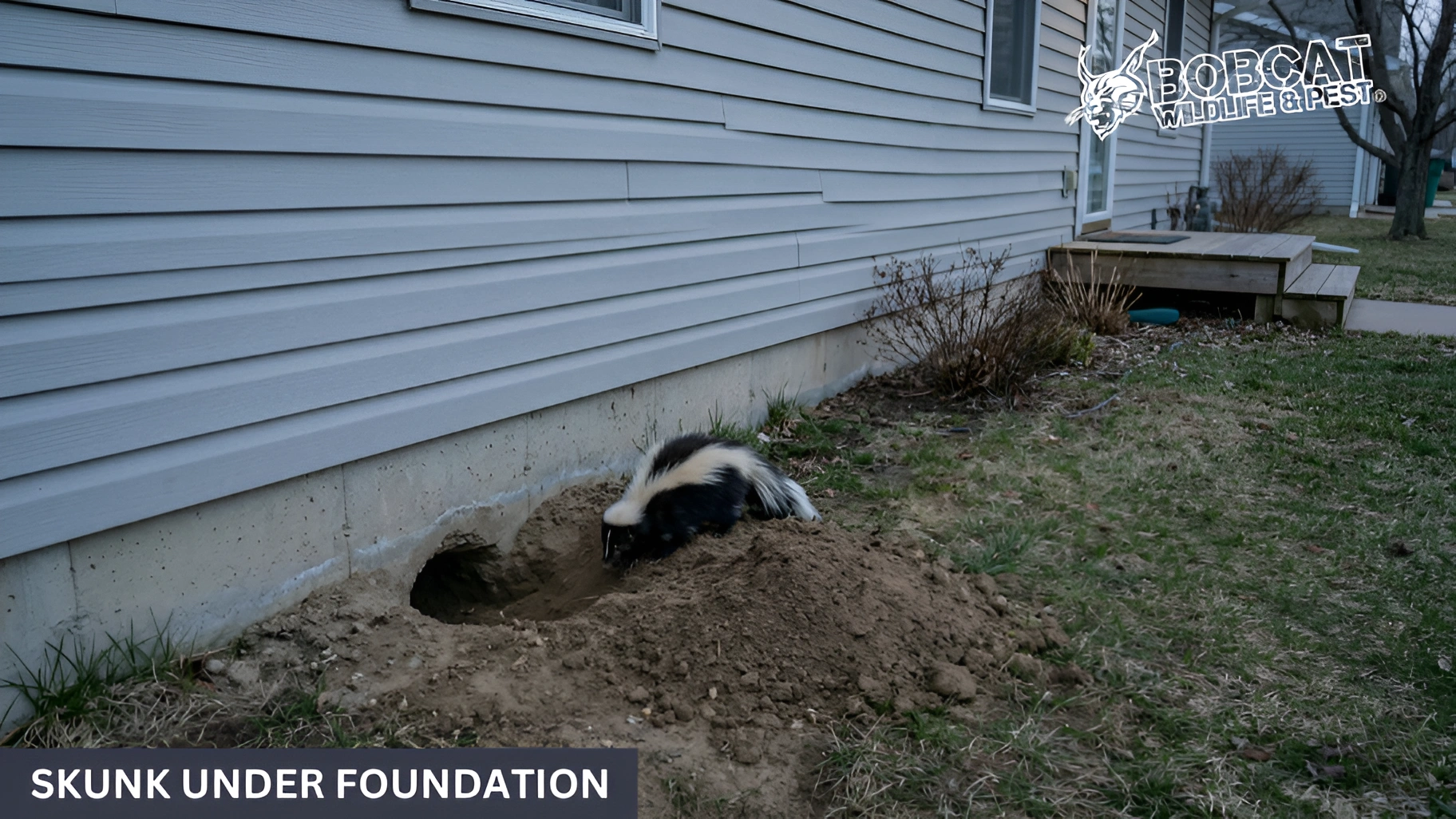
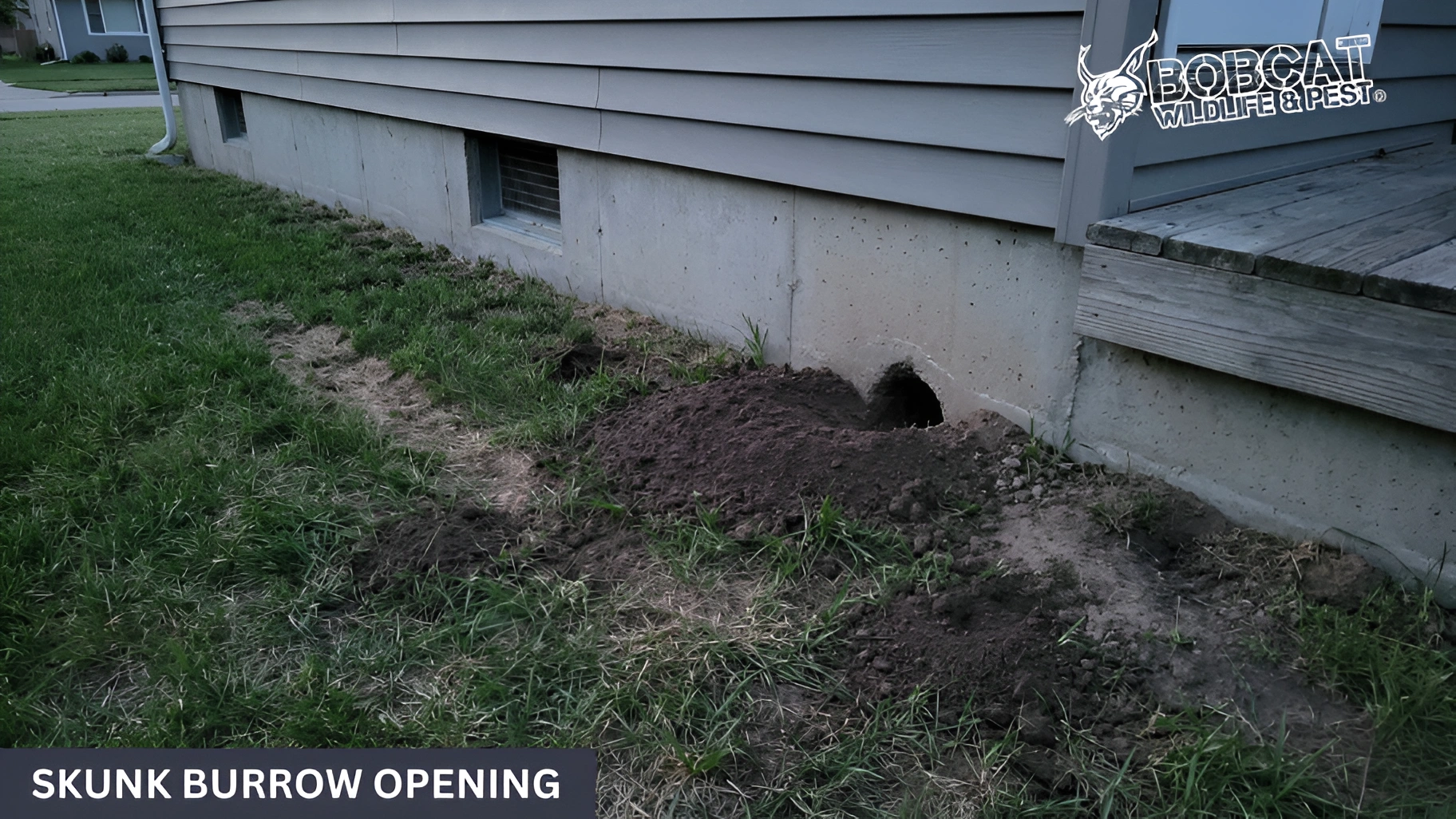
A low, rounded entry hole along the foundation, usually only a few inches tall
Dirt pushed outward in a neat pile near the opening
Repeated shallow digging in the same section of lawn
Movement, scratching, or rustling sounds after dark from one steady location
Skunks prefer tight, protected spaces. They usually den directly against structures rather than out in the open yard.
Derek Brownmiller says in Iowa City, activity often appears near crawlspace vents, beneath porches, under concrete stoops, or along deck edges where there is solid cover on multiple sides.
If you are noticing several of these signs in one concentrated area, it is more likely an active den and not just a skunk passing through.
Why This Is Happening in Iowa City Right Now
If this feels like it showed up overnight, it usually didn’t. It’s seasonal behavior, not random bad luck.
In late winter and early spring, skunks begin looking for secure den sites before breeding season fully ramps up. That is when they shift from roaming to settling. Once they choose a spot, they tend to stay.
In Iowa City, several local conditions make homes especially appealing this time of year:
Freeze and thaw cycles that loosen soil along foundations
Older homes with small gaps along porch slabs or step joints
River-adjacent areas and wooded lots that naturally support higher wildlife traffic
Crawlspaces and decks that block wind and retain subtle ground warmth
Derek explains that many homeowners expect wildlife problems in summer, but den selection often starts well before consistent warm weather arrives in Eastern Iowa.
That is why it can catch people off guard. The yard may look calm during the day, but activity is happening quietly at night while the animal is establishing a protected nesting site.
Why a Skunk Under Your House Can Become a Bigger Problem
Once a skunk establishes a den, the issue is no longer just about an animal outside. It becomes a structural and sanitation concern.
A skunk under your house does more than take up space. Over time, secondary problems can develop that are harder to reverse than the original entry.
Here is what can happen if it goes unchecked:
Spray odor seeping upward through vents, plumbing gaps, and floor penetrations
Nesting material mixing with insulation, which traps scent and reduces energy efficiency
Fleas transferring from the den area into crawlspaces and eventually into living areas
Soil displacement along the foundation, slowly enlarging weak points
A litter of baby skunks, which changes removal timing and increases complexity
Derek notes that in Iowa City homes, one of the most underestimated issues is odor absorption. Spray particles can bind to porous materials under the home, especially insulation and subflooring.
Even if the skunk eventually leaves on its own, the smell often does not. Without proper cleanup and sealing, what started as a quiet den can turn into a long-term odor and structural problem.
The longer it remains active, the more layered the solution becomes.
How to Get Rid of a Skunk Under Your House Safely
Once you’ve confirmed it is an active den, the next step is solving it without making the situation worse.
Most homeowners searching for how to get rid of a skunk under house areas safely want something quick. The challenge is that quick fixes often ignore how skunks actually behave.
What Usually Does Not Work
These approaches often delay real resolution:
Placing mothballs, ammonia, or strong scents near the opening
Closing the hole before confirming the skunk is fully out
Using lights, radios, or vibration devices and hoping the animal leaves
Shoveling soil into the burrow without fixing the structural gap
Skunks are persistent when they feel secure. If the space offers protection, they often wait out deterrents. And sealing too early can trap the animal underneath, creating a bigger odor or damage issue.
A safe, lasting solution follows a controlled process built around timing and verification:
A full inspection of the foundation line, not just the visible burrow
Determining whether young are present, which directly affects removal strategy
Humane trapping or monitored exit methods based on current activity
Use of a one-way exclusion device once the den is inactive
Reinforcement and permanent sealing of vulnerable edges
Derek emphasizes that timing is everything. In Iowa City homes, sealing even slightly too early can mean reopening the structure days later.
The difference between a temporary fix and a lasting solution comes down to confirmation, control, and proper sequencing.
It is not about forcing the animal out. It is about making sure it cannot return once it leaves.
How to Get Rid of Skunks Under a Shed or Around Your House
Not every skunk problem starts under the main foundation. In many Iowa City properties, the den forms under a shed, deck, porch, or other outbuilding.
Homeowners often search how to get rid of skunks under shed structures because these spaces offer quiet cover without the disturbance of daily household activity.
Sheds and detached structures tend to attract skunks for a few practical reasons:
Open soil edges with no buried barrier
Loose skirting or untreated gaps
Less foot traffic, which makes the space feel undisturbed
Low clearance that limits predator access
Unlike a poured foundation, most sheds are not anchored with deep footings. That makes the soil around them easier to tunnel and easier to return to if not reinforced properly.
When people search how to get rid of skunks around your house, it often begins with scattered lawn digging. Following those shallow holes frequently leads back to a protected edge like a shed base or deck perimeter.
The removal process follows the same core principle: confirm active use, ensure no young are present, remove the skunk safely, and then secure the access point.
The difference is that sheds usually require ground-level reinforcement, such as buried barrier materials, to prevent future digging.
Eliminating the animal solves the immediate problem. Securing the vulnerable edge is what keeps it from happening again.
When to Call a Skunk Removal Professional in Iowa City
There is a point where trying to manage it yourself can cost more than it saves.
If you are noticing any of the following, it is time to involve a skunk removal professional in Iowa City:
- 1
The odor continues to intensify or lingers well beyond a few days
- 2
You believe there may be baby skunks under the structure
- 3
Spray smell is entering crawlspaces, vents, or living areas
- 4
Previous DIY attempts have not reduced activity
- 5
Digging has expanded along the foundation, porch, or shed base
At this stage, the issue usually requires more than surface-level deterrents. The longer an established den remains active, the greater the chance of odor absorption, insulation contamination, or structural weakening.
Derek Brownmiller often reminds Iowa City homeowners that wildlife rarely relocates once it feels secure. Waiting typically makes removal more complex and cleanup more involved.
If you suspect there is a skunk under your home or outbuilding in the Iowa City area, working with a licensed professional helps ensure the animal is removed safely and the entry point is secured properly so the problem does not return.
FAQs About Skunks Under Houses in Iowa City
Certainty comes from confirming three things: an active entry point, consistent nighttime movement, and maintained digging. A true skunk den will show signs of upkeep.
The soil around the opening often looks freshly worked, not weathered. There may also be faint body drag marks or pressed grass along a short path leading to the hole.
A professional inspection may include checking for heat signatures, crawlspace disturbance, or odor concentration mapping to confirm whether a skunk is actively living under the structure rather than simply passing through.
Skunks are highly nocturnal and cautious. It is common to smell them repeatedly without ever seeing them.
If the odor is strongest near one section of the foundation and appears at similar times each evening, that often suggests den activity.
By contrast, a single strong odor that fades quickly is more likely from a defensive spray somewhere in the neighborhood. Consistency is the key difference.
Yes, but the sound profile is subtle. You are more likely to hear slow scratching, soil shifting, or light thuds from movement rather than loud chewing or pounding.
The noise typically occurs shortly after dusk when the skunk exits to forage and again before sunrise when it returns.
If sound is coming from one concentrated area rather than moving across the entire crawlspace, that points toward a fixed den location.
A skunk burrow opening is usually low and oval shaped, often just a few inches tall but wider than it is high.
The edges are smooth because skunks use their front claws to scrape soil outward in a controlled way.
You may notice compacted dirt pushed forward in a neat mound. Unlike raccoons, skunks do not tear or splinter materials.
They exploit existing soil gaps and expand them gradually.
If the location offers protection from wind and predators, a skunk can remain for weeks or months.
During breeding season, a female may stay until young are mature enough to leave. Skunks are not constantly roaming.
Once they establish a den that feels safe and stable, they tend to reuse it nightly unless forced out properly.
Skunks are not aggressive by nature, but they defend themselves through spray.
The greater risk comes when pets or people unknowingly approach the den.
If startled in a confined area under a house, the skunk has limited escape routes and may spray more readily.
Rabies exposure is rare but possible, which is why direct interaction should always be avoided.
Skunks do not chew through concrete or wood framing. However, repeated digging along the foundation can widen soil gaps and create erosion points.
If they nest in insulation, they compress it, reducing its thermal effectiveness.
Nesting material combined with moisture can also create odor retention and sanitation concerns over time.
Yes. Skunks are recognized rabies carriers in Iowa. They can also host fleas, ticks, and intestinal parasites.
While transmission to humans is uncommon without direct contact, pets that investigate the den are at higher risk.
Even without disease transfer, flea movement from the den area into crawlspaces can become a secondary pest issue.
Spray in an enclosed crawlspace behaves differently than spray outdoors. The odor compounds can bind to porous materials such as wood subflooring and insulation.
From there, scent can travel upward through small air gaps, plumbing penetrations, and duct chases.
Without targeted cleanup and ventilation, the smell may linger far longer than most homeowners expect.
An active wildlife den can become a concern during inspections.
Visible burrow openings, odor in crawlspaces, or contaminated insulation may require documented remediation.
Even if minor, buyers often request correction before closing, which can delay transactions and increase repair costs.
Safe removal involves confirming that the animal is actively using the den, determining whether young are present, and selecting the correct method for that timing.
This may include monitored exit strategies or humane trapping under proper guidelines.
After the animal is out, reinforcement and sealing of all vulnerable edges are critical to prevent reuse of the same location.
While some homeowners attempt it, improper removal increases the chance of spraying or trapping the animal inside.
Iowa wildlife regulations also govern trapping and relocation practices.
Without understanding those rules and behavioral timing, DIY efforts often result in repeat activity.
Skunks can tolerate strong smells better than people expect.
These products may create temporary hesitation, but they rarely override the security of a chosen den.
In many cases, the animal simply waits until the disturbance fades.
Blocking the hole without confirming the skunk has exited can trap it underneath.
This can lead to spray, additional digging at alternate foundation points, or even odor issues if the animal cannot escape.
Proper sequencing is essential before sealing.
Skunks are regulated wildlife in Iowa. Certain trapping methods and handling practices must follow state guidelines.
Violating these regulations can result in fines. Licensed wildlife professionals stay current with these rules to ensure compliance.
Shed removal follows the same principles as removal under a house.
The key steps are confirming active use, ensuring no young are present, guiding the animal out properly, and reinforcing the base perimeter with secure materials that prevent re-digging.
Simply filling soil against the shed rarely prevents recurrence.
Most nighttime lawn digging is feeding behavior. Skunks search for grubs and insects just below the surface.
These holes are usually small and scattered. Den-related digging, by contrast, is concentrated at a single structural edge.
Reducing attractants is essential. Secure trash lids, avoid leaving pet food outdoors, and eliminate brush piles that provide cover.
Humane exclusion and structural sealing are more effective long term than repellents.
If the original access point remains vulnerable, another skunk may reuse it.
Skunks look for easy shelter and will reuse small structural gaps if they remain accessible.
Preventive reinforcement is what stops repeat occupancy.
Long-term prevention includes reinforcing foundation edges, repairing vent screens, installing proper barrier materials where soil meets structure, and monitoring areas where freeze and thaw cycles create small gaps.
Periodic inspection of these points is often the difference between a one-time issue and a recurring problem.
If you are unsure whether the activity under your home is active or escalating, a local evaluation can help clarify the next step before the issue becomes more complex.